




South Australian startup Paladin Space is one step closer to launching its world-first space debris removal technology into orbit, after receiving a major Federal Government funding boost and forging a strategic partnership with one of Italy’s oldest universities.
The company was recently awarded a $250,000 grant through the Commonwealth’s Industry Growth Program, which will accelerate critical qualification testing of its Triton payload – an innovative system designed to capture and classify small debris in space.
The funding will be used to conduct thermal vacuum chamber and vibration testing, qualifying the Triton unit for launch.
Paladin will also perform a zero-gravity test aboard an aircraft to simulate microgravity conditions, ensuring the payload’s novel capture and imaging technology functions effectively with floating debris targets.
Paladin Space CEO Harrison Box said the tests are critical ahead of the company’s planned in-orbit demonstration mission aboard the International Space Station in late 2026 or early 2027.
“These tests are essential to de-risk our first mission,” Mr Box said. “They provide assurance that our system works in a simulated space environment and will allow us to begin servicing our first customers following the in-orbit demonstration mission, accelerating our path to market.”
During the ISS mission, astronauts will interact with the Triton payload by feeding it debris targets to capture, validating its performance in orbit.
The project will also drive significant growth for Paladin, with plans to hire three new engineers in Adelaide and expand its business development team.
“We’re aiming to grow our team significantly over the next five months,” Mr Box said. “This expansion will help us in our mission to become the world leader in small debris removal.”
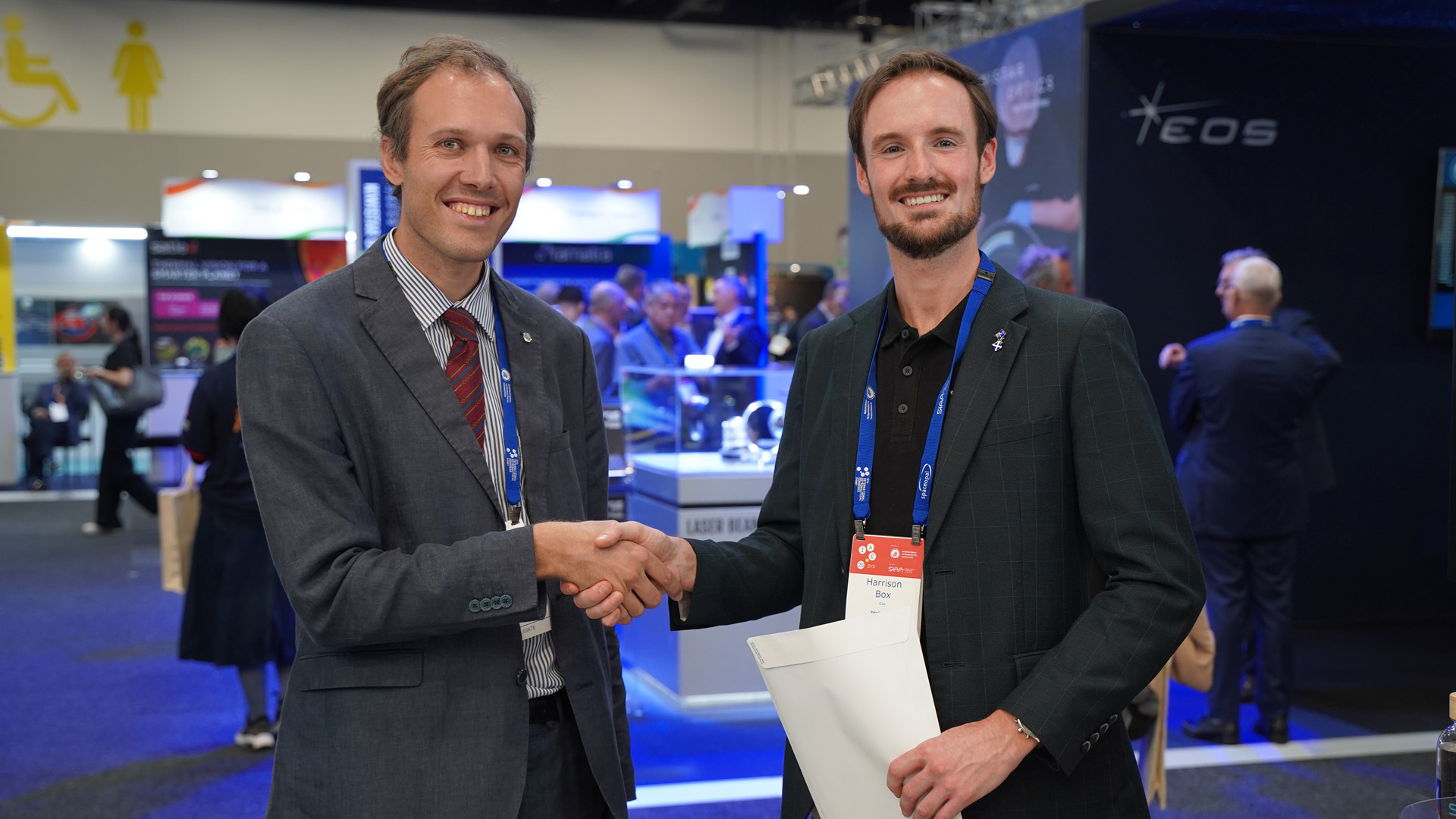
In another major development, Paladin recently signed a Memorandum of Understanding with Italy’s University of Padua – one of the world’s oldest universities – to access experimental data from hypervelocity impact tests conducted on the PICOSAT-1 and PICOSAT-2 satellites.
Paladin will use this data to train the Triton’s machine learning computer vision model, enhancing its ability to classify space debris with a high degree of accuracy.
“This collaboration positions us as one of the only companies globally with a machine learning system trained on replica space debris samples,” Mr Box said. “It’s a huge step forward in making our classification technology more effective.”
Paladin Space and the University of Padua plan to continue working together on future hypervelocity impact tests, further strengthening the company’s technical capabilities and global partnerships.
—
Photo: Paladin Space CEO Harrison Box pictured with Lorenzo Olivieri from the University of Padua, Italy.
