




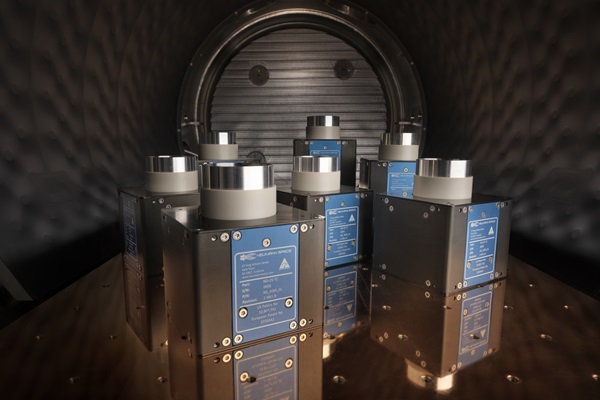
South Australian-based electric propulsion company, Neumann Space, have announced the successful on-orbit deployment of their Neumann Drive® ND-25 aboard SpaceX’s Transporter-16 rideshare mission.
The deployment marks another milestone in the company’s growing flight heritage, which Chief Executive Officer Herve Astier explaining its importance.
“We’re no longer just demonstrating propulsion systems, we’re manufacturing and delivering them at scale,” said Mr Astier.
“The Neumann Drive is designed to be simple to integrate, responsive in orbit and available when operators actually need it.”
“For teams building constellations today, those factors matter as much as any single performance figure.”
The Neumann Drive is a unique, lightweight, and high-efficiency solar-electric propulsion system that uses a solid metallic propellant rod to produce thrust by utilising a patented Centre-Triggered Pulsed Cathodic Arc Thruster (CTPCAT) technology.
The Neumann Drive range supports CubeSat to SmallSat missions, delivering 25W to 300W+ input power. Designed for full manoeuvring capability, including orbit raising, station-keeping and deorbit, the system can fire within six seconds of a cold start. This rapid response enables critical operational capability in collision avoidance, formation flying and rendezvous and proximity operations.
Neumann Space’s on-orbit flight heritage includes the January 2026 launch of an ND-50 unit aboard Surrey Satellite Technology Ltd’s (SSTL) CarbSAR mission, and earlier demonstrations with Skykraft, Inovor Technologies and Space Inventor under the ESA Pioneer Program.
The company has now confirmed a quarterly cadence for future deployments, which will next launch aboard SpaceX Transporter-17 and Transporter-18 missions in 2026.
Neumann Space is currently exhibiting as part of an Australian delegation at the 2026 Space Symposium in Colorado Springs, April 13–16. Find Neumann Space and other leading South Australian space companies at the Australian Pavilion on the Broadmoor West Tower Lawn.
