




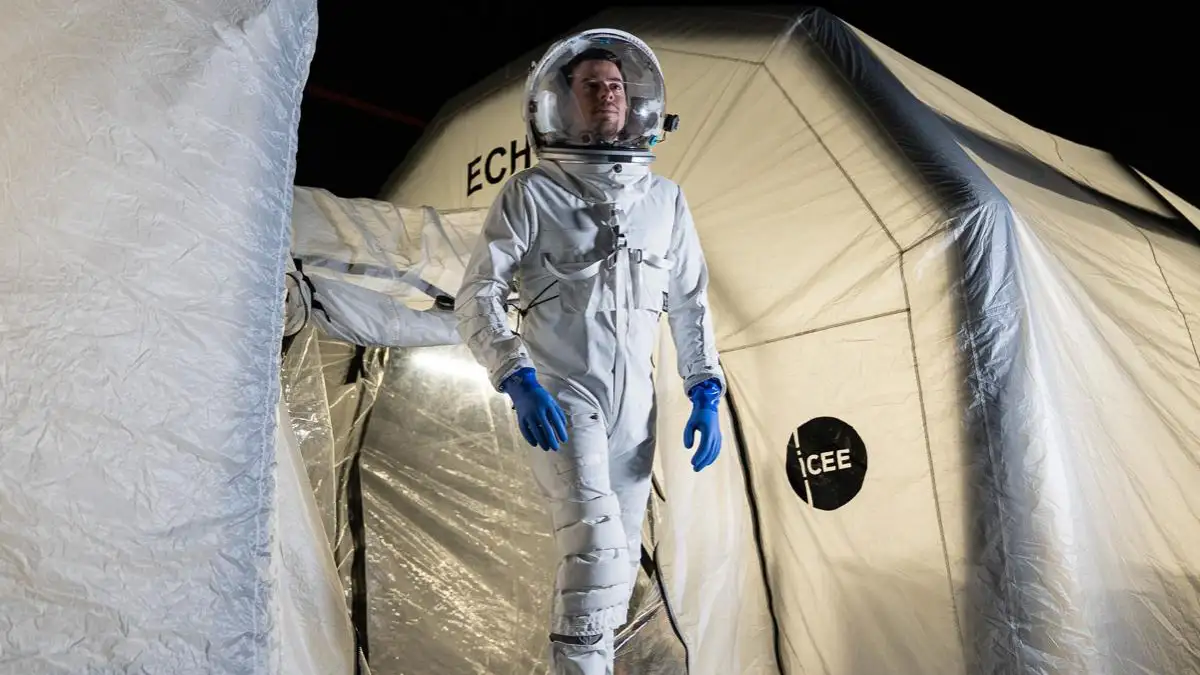
The University of Adelaide and international space testing, research and development start-up ICEE.Space have teamed up for the ADAMA Analogue Astronaut Mission in Adelaide, running from 9 to 22 October 2025.
The two-week simulation space mission is the only one of its kind in Australia, and is part of the World’s Biggest Analog initiative, which includes simultaneous missions in the USA, Austria, Poland and Brazil.
Four analogue astronauts will conduct experiments at the University’s Extraterrestrial Environmental Simulation (Exterres) CRATER facility at Roseworthy campus. This unique testbed mimics lunar conditions, providing a controlled environment for testing sustainable mission systems, next-gen spacesuits and habitats.
Associate Professor John Culton, Director of the Andy Thomas Centre for Space Resources (ATCSR) at the University of Adelaide, said the University was excited to be working with ICEE.Space on the ADAMA Mission.
“The University’s Exterres CRATER facility is a research testing environment that simulates conditions on the Moon including the unique lighting experienced during the course of a lunar day,” Professor Culton said.
The mission will also explore how astronauts cope with living in space, testing mission systems, next-generation spacesuits and habitats. Functional MRI scans by the South Australian Health and Medical Research Institute and the National Imaging Facility will study the changes in brain connectivity due to isolation and mission tasks.
ICEE.Space Co-Founder Charlotte Pouwels emphasised the importance of earth-based analogue missions.
“Analogue missions on Earth are used to test protocols, interventions, and new techniques before trying them in space,” she said. “They also help prepare for future Moon and Mars-like analogues through research involving team dynamics, diagnosing and treating medical issues in space, and investigating other critical factors for analogue space exploration, including simulating potential hazards.”
The ADAM Mission is the largest space analogue mission carried out in history, and as the only one simulating multiple outposts demonstrates the potential of internation collaboration.
Professor Anna Ma-Wyatt, Director of Astronaut-autonomy teaming at the ATCSR and an expert in behavioural neuroscience at the University of Adelaide, also emphasised the mission’s contribution to astronaut wellbeing.
“The ADAMA mission will contribute to our understanding of how the novel physical environment of space affects astronauts’ mental and cognitive wellbeing and how we can mitigate the risks associated with long-term space exploration,” said Professor Ma-Wyatt.
The insights acquired from the ADAMA mission will be utilised to inform and guide future endeavours in deep space exploration.
—
Image credit: University of Adelaide – Isaac Freeman
