





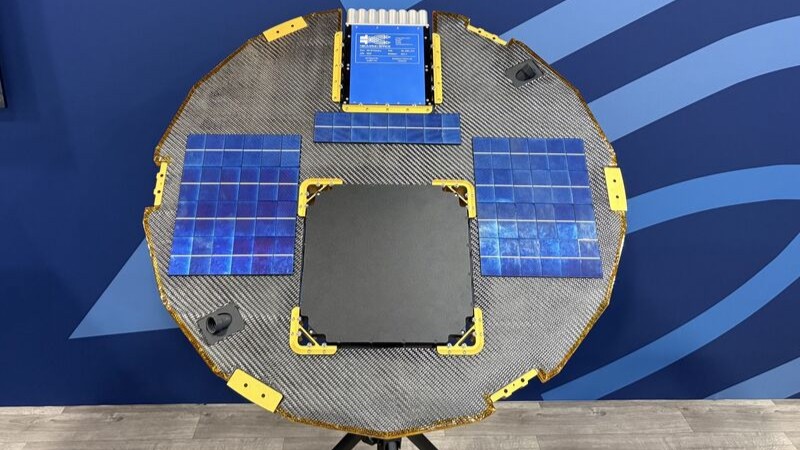
Adelaide space technology company, Neumann Space, has signed a commercial licence agreement with a US space research and engineering firm, set to advance a new generation of satellite technology.
Signed last month, the agreement will see Neumann work with The Aerospace Corporation, known for its innovative DiskSat technology, to integrate the flat satellite DiskSat architecture with Neumann’s Flatypus electric propulsion platform.
Flatypus is a new, low-profile electric propulsion system which is specifically designed to meet DiskSat’s unique, stackable DiskSat architecture.
The partnership creates a pathway to deepen sovereign manufacturing expertise in advanced satellite manufacturing and contribute Australian capability to the US innovation, which was developed in partnership with NASA and the U.S. Space Force Space Systems Command to offer a fundamentally different approach to a conventional box-shaped satellite bus.
CEO of Neumann Space Herve Astier said the licence agreement demonstrates how Australian and American technologies can complement each other.
“Aerospace has developed an innovative satellite architecture; Neumann Space brings unique propulsion technology and Australian advanced manufacturing capability,” Mr Astier said. “Together, they have the potential to enable new commercial and sovereign mission architectures.”
Managing Director of Neumann Space James Schultz said the Flatypus uses the core technology of the Neumann Drive which has been redesigned into a propulsion system that is as flat as the spacecraft itself.
While it still provides propulsion and control capability, it also preserves valuable volume for payloads and other mission systems.
“There is no conventional propellant tank, no complex plumbing and no need to compromise the DiskSat architecture to accommodate propulsion,” Mr Schultz said.
“That creates something very powerful: a standardised satellite architecture combined with a standardised electric propulsion system, both designed for simplicity and scalable manufacturing.”
The combined architecture is particularly relevant to an increasing number of missions requiring larger numbers of spacecraft to be manufactured and launched rapidly.
It is suited to communications, Earth observation, space domain awareness, responsive space and other commercial and national security applications where deployment speed, manoeuvrability and manufacturing scale are increasingly important.
Catherine Venturini, principal investigator for the DiskSat demo mission said the Virginia-based corporation is excited to see how the partnership will inspire the next generation of missions.
“DiskSat was designed to empower companies and drive the next wave of commercial space innovation,” Ms Venturini said.
“By making this technology available globally, we’re advancing industry standards and shaping a more dynamic, accessible future for commercial space.”
DiskSat’s two-dimensional planar architecture means it can be tightly stacked for launch and then individually deployed in orbit, enabling multiple spacecraft to be efficiently packaged within a single launch vehicle.
Because of its flat design, it also offers a large surface area for solar arrays, antennas, sensors and payloads, as well as improved atmospheric drag management, particularly in Very Low Earth Orbit (VLEO).
Other advantages include thermal management, efficient body-mounted power generation and manufacturing simplicity through standardised structures and interfaces.
Neumann Space expects to launch its first Neumann Drive enabled DiskSat by 2028.
