





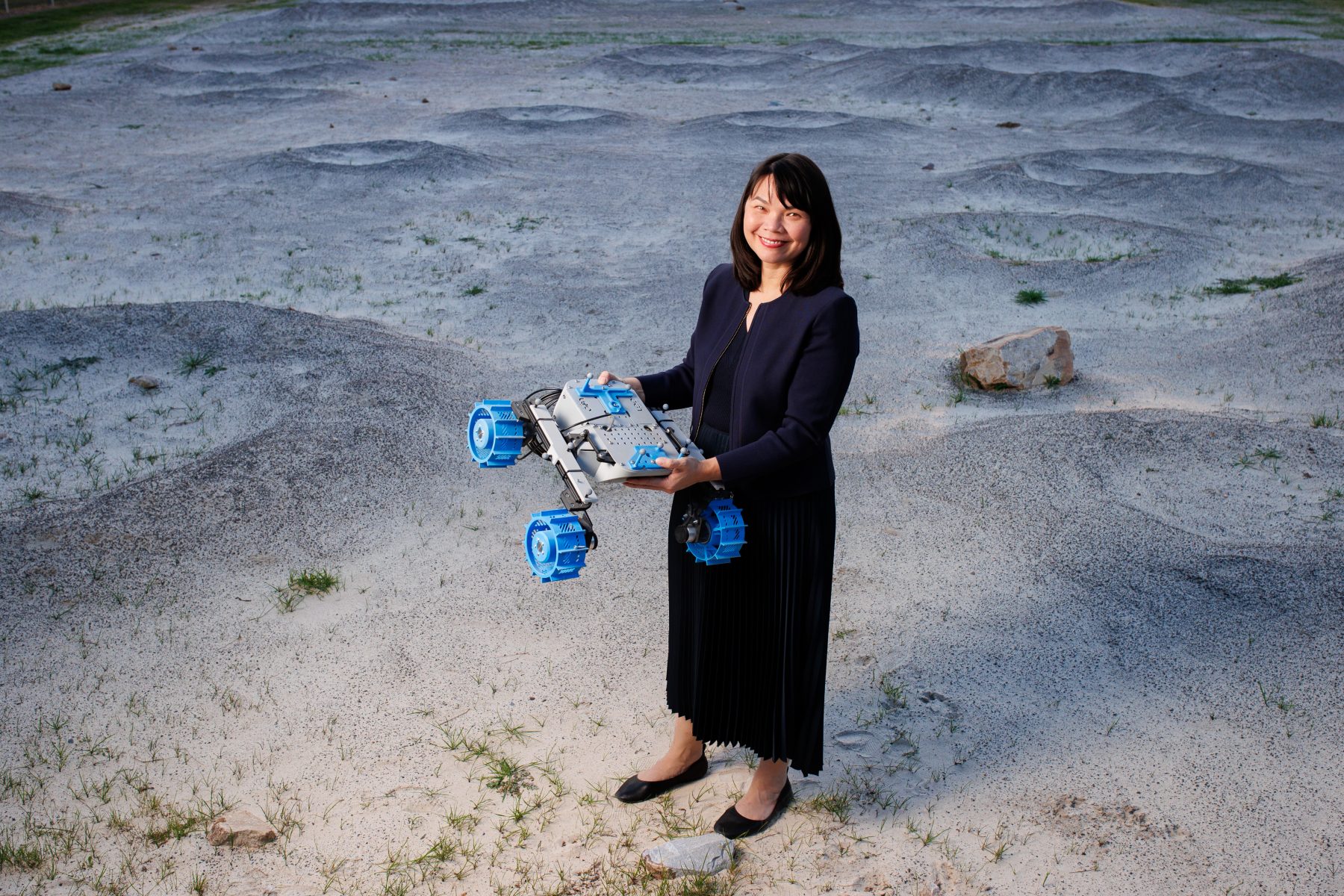
In the quiet, rolling paddocks of Adelaide University’s Roseworthy campus, you might not expect to see the future of lunar exploration taking shape.
But at the Exterres facility, just 40 minutes north of Adelaide, the red dirt of South Australia doubles as the moon’s surface, providing a world-class testbed for the next frontier of off-Earth exploration and the human endurance that will underpin it.
For two weeks last October, Australian researchers took part in the first-ever ADAMA mission (Astronautical Demonstration of an Analogue Mission in Australia), an initiative of Adelaide University’s Andy Thomas Centre for Space Resources (ATCSR). The focus of this first mission was a proof of concept for a raft of work with international partners that lays the foundation for future analogue missions at the Covered Regolith Analogue Terrain for Experimental Research (CRATER) facility.
A timely connection to the galaxy
Five months later, on the day NASA successfully launched Artemis II, the first crewed flight beyond Earth’s orbit in more than 50 years, the connection to the work at Roseworthy felt more vital than ever for the ATCSR’s Director of Astronaut Autonomy teaming, Professor Anna Ma-Wyatt.
As the world watched the latest generation of astronauts head towards the Moon, Prof Ma-Wyatt’s team was immersed in reviewing their own mission with ADAMA and planning for their next mission. The next mission will focus on human-machine teaming to support future lunar landings.
“Analogue missions on Earth are used to test protocols and new techniques before they are tried in space,” explains Prof Ma-Wyatt, an expert in human-machine teaming.
Her work focuses on building resilient hybrid teams, where AI isn’t just a tool but a partner that supports human decision-making under pressure.
Prof Ma-Wyatt explains that the goal is to establish common ground with an autonomous system to enable a real-time partnership in which the AI agent and the astronaut can monitor each other for errors and provide mutual support.
“Working at Roseworthy allows us to see the friction points in human-machine teaming,” she says. “In the future, we hope the robot will be able to monitor the human and say, ‘Hey, this is a bit weird. Can you help me here?’ and vice versa. This prevents the turn-taking lag that usually happens with technology and turns it into real-time collaboration. That level of trust is what will eventually enable us to build permanent bases on the Moon.”
Ground control in Roseworthy
The mission’s success depends on the Andy Thomas Centre for Space Resources’ transdisciplinary character. Far from being merely an engineering project, the ATCSR brings together a diverse range of expertise, including space law, psychology, and architecture, to address the complex challenges of long-term habitation.
This collaborative ecosystem has made Roseworthy a global magnet – the ATCSR’s partners include national space agencies, global aerospace companies, and world-leading research organisations, says Professor Ma-Wyatt. The ATCSR is part of the Roo-ver consortium, working closely with ELO2 to prepare an Australian rover for a mission targeting the lunar South Pole later this decade.
“The innovation ecosystem we are building at Roseworthy enables us to translate cutting-edge research into solutions that work with industry,” she says.
The Exterres facility includes a massive 4,000 sqm outdoor testing area and a purpose-built, configurable indoor facility, CRATER, with regolith (space soil) simulants and specialised lighting. Together, these facilities replicate key aspects of the lunar landscape.
“The research testing environment that simulates conditions on the Moon includes the lighting experienced throughout a lunar day,” Professor Ma-Wyatt says. This is a critical detail, as the Moon’s harsh light creates pitch-black shadows that can confuse both human eyes and robotic sensors.
By identifying potential problems in this controlled environment, the team ensures those same mistakes don’t occur when a life is on the line 384,400km away.
Ground control in Roseworthy
The mission’s success depends on the Andy Thomas Centre for Space Resources’ transdisciplinary character. Far from being merely an engineering project, the ATCSR brings together a diverse range of expertise, including space law, psychology, and architecture, to address the complex challenges of long-term habitation.
This collaborative ecosystem has made Roseworthy a global magnet – the ATCSR’s partners include national space agencies, global aerospace companies, and world-leading research organisations, says Professor Ma-Wyatt. The ATCSR is part of the Roo-ver consortium, working closely with ELO2 to prepare an Australian rover for a mission targeting the lunar South Pole later this decade.
“The innovation ecosystem we are building at Roseworthy enables us to translate cutting-edge research into solutions that work with industry,” she says.
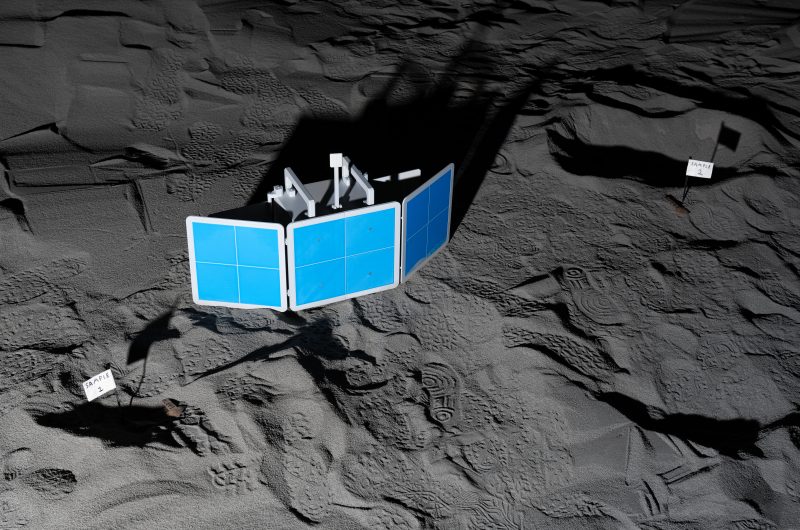
The Exterres facility includes a massive 4,000 sqm outdoor testing area and a purpose-built, configurable indoor facility, CRATER, with regolith (space soil) simulants and specialised lighting. Together, these facilities replicate key aspects of the lunar landscape.
“The research testing environment that simulates conditions on the Moon includes the lighting experienced throughout a lunar day,” Professor Ma-Wyatt says. This is a critical detail, as the Moon’s harsh light creates pitch-black shadows that can confuse both human eyes and robotic sensors.
By identifying potential problems in this controlled environment, the team ensures those same mistakes don’t occur when a life is on the line 384,400km away.
International talent, local dirt
For Kato Claeys, a PhD student from Belgium, the allure of Adelaide’s space ecosystem proved irresistible. Claeys moved across the globe to join the ADAMA mission and pursue her research at the ATCSR.
“Adelaide is becoming a global magnet for space innovators,” Claeys says. After participating in 12 previous analogue missions in Poland and the US, she moved specifically because of Adelaide University’s focus on Lunar Architecture. She is now part of the Lunar Architecture Research Group in the ATCSR.
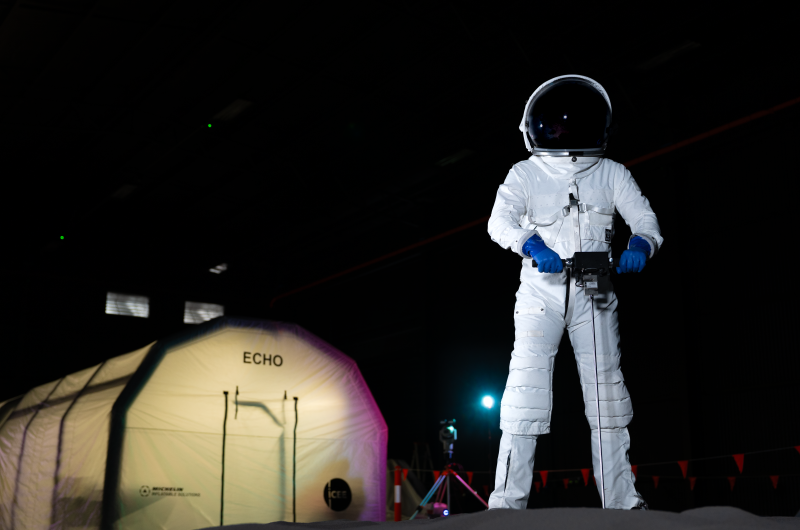
Living in the simulated habitat for the entire two-week mission was a sensory wake-up call.
Claeys and her three crewmates had to manage an intense schedule of psychological tests, equipment maintenance, and plant-growth experiments while navigating the weight of isolation.
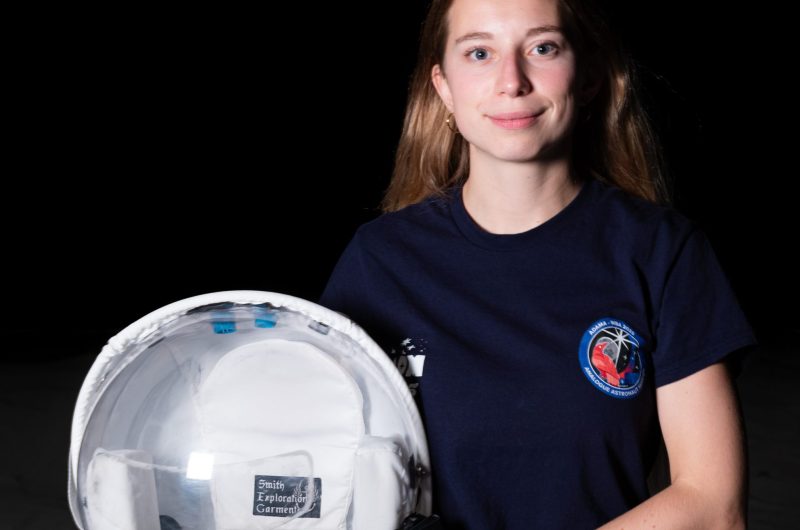
“We had a fixed schedule from mission control every day,” Claeys recalls. “You have to maintain the habitat, perform experiments, and manage the psychological weight of being ‘off-world’ while still in regional South Australia.”
During her two weeks in the lunar habitat, she wasn’t just a researcher; she was a test subject for the future of civil engineering in space.
“I was interested in the lived experience, the sensory details like the heat, the isolation, and the feel of the gear. Being in the habitat for two weeks, you realise that even small things, like the lack of a ‘normal’ diet or limited space for exercise, become major psychological factors when you’re trying to do complex engineering work.”
A sovereign future
This research is a critical part of Australia’s growing sovereign space capability and is close to the Australian Space Agency HQ, located at Lot Fourteen in Adelaide. The CRATER facility at Roseworthy is also home to the Cloud-based Orbital Robotics Laboratory (COROL), Australia’s first orbital robotics testbed. COROL is already supporting Space Machines Company’s groundbreaking work tracking of satellites and space debris.
By pushing the boundaries of human-machine teaming in the backyard of a regional town, the team at ATCSR is ensuring that when the next astronaut mission includes a Moon landing, the technology will have been Earth-tested at Roseworthy first.
What is an Analogue Astronaut?
Analogue astronauts are the stunt doubles of space exploration. They live and work in simulated environments on Earth to test how humans and technology cope with the isolation and stress of a real mission before we ever leave the atmosphere.
—
Story originally published in Boundless Magazine, Issue 05. Read the original on the Innovation Places South Australia website here.
