




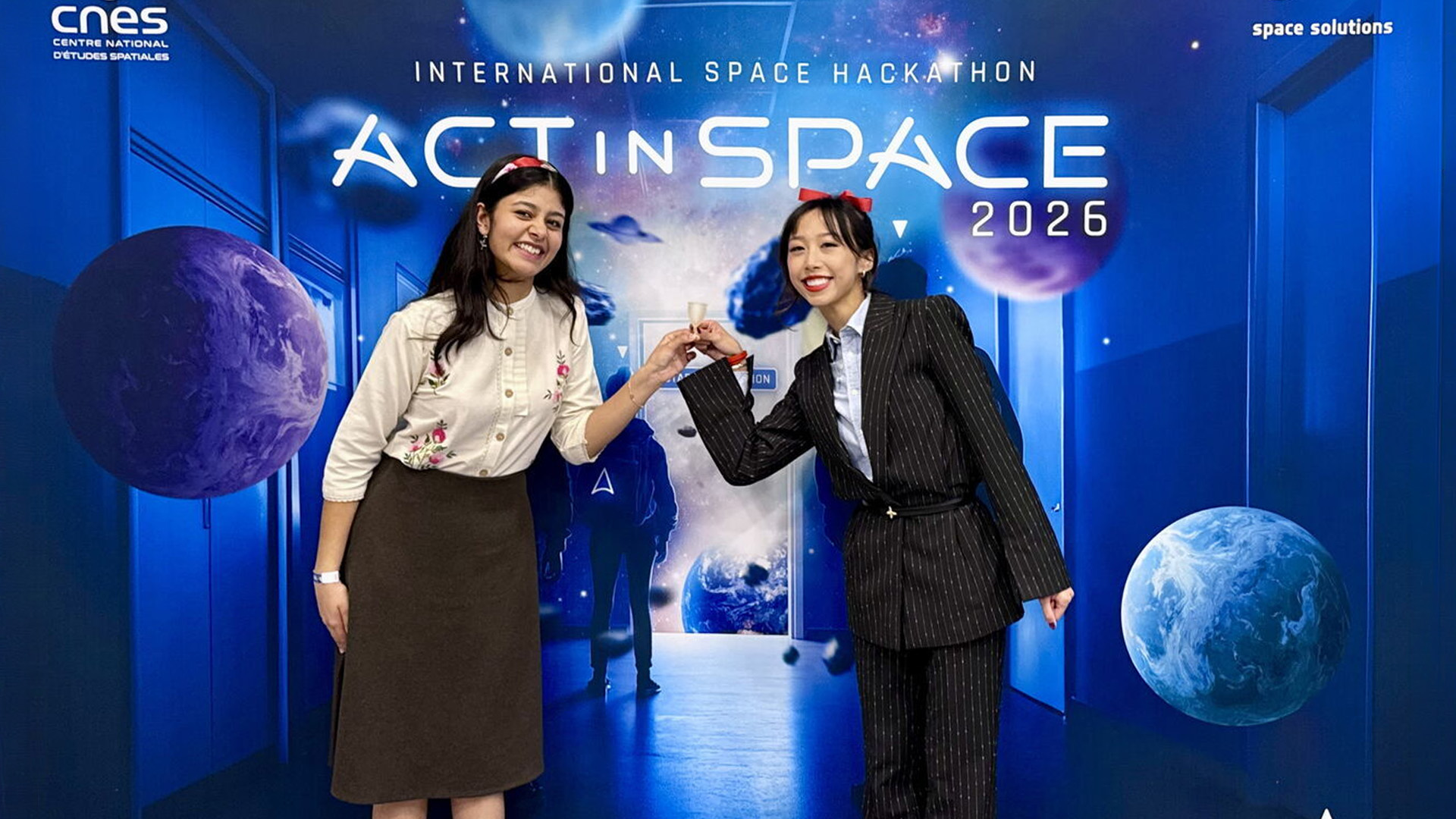
When Adelaide University engineering students Mei He and Shradha Angrish stepped onto the stage at the 2026 global ActInSpace finals in April, they weren’t pitching rockets or satellites. Instead, as The Red Planet team, they were addressing a problem that has quietly followed female astronauts for decades: how menstruation is managed in space.
It is an issue that will only grow more pressing as humanity prepares for longer missions beyond Earth orbit, and one that ultimately propelled the South Australian duo into the global top five at the prestigious international innovation competition.
Mei and Shradha earned their place on the world stage after winning the ActInSpace Australia competition hosted at the Innovation and Collaboration Centre in January. Their victory secured them an invitation to France, where they competed against teams from around the world in the 24‑hour challenge that uses technology and data to solve challenges in space.
With limited research and publicly available data on how menstruation is managed during spaceflight, the challenge stood out to the pair. Modern spacecraft are designed as tightly controlled, closed-loop environments, recycling air, water and waste. Yet when it comes to periods, astronauts currently depend on disposable products or hormone suppression, solutions that add to onboard waste, carry potential health risks, and introduce additional stress.
The Red Planet team set out to rethink this status quo. Their concept proposed a space-adapted menstrual management system based on a menstrual cup modified with an innovative valve designed to function in microgravity. The system would allow menstrual fluid to be collected safely for up to 12 hours, before being emptied and processed as a plant fertiliser, creating a fully integrated, closed-loop solution suitable for long-duration missions.
The idea resonated with judges and participants alike. After progressing through their semi-final heat, Mei and Shradha were announced among the global top five teams and invited to pitch again in front of a packed auditorium, competing for the overall prize of a zero-gravity flight experience.
While first place ultimately went to a Senegalese team developing a constellation of CubeSats designed to rapidly transfer space data to users on Earth, the experience left a lasting impression on the South Australian students.
“It was huge to make it to the global top five,” Ms Angrish said. “But the bigger win for me was the perspectives we gained and the fact that we actually stood in front of a huge auditorium, pointing to anatomy diagrams talking menstruation in microgravity, and people listened.”
For Mei, the competition was also a powerful reminder of the role innovation can play in reducing barriers and expanding participation.
“I am very aware of the privilege I’ve had growing up, and this event was a reminder of that,” she said. “I feel this responsibility to use the privilege that I have to reduce barriers for those who don’t have it and look for opportunities to uplift others.”
Feedback from judges and fellow competitors was overwhelmingly positive, with many expressing genuine interest in continuing the conversation and helping develop the idea further. The openness of those discussions stood out to the team as much as the technical feedback.
Although disappointed not to take home the top prize, both students say the sense of global community was one of the most rewarding aspects of the competition.
“When the winners were announced, the happiness on their faces was contagious,” Ms Angrish said. “We were competitors, but we were also just people who love space—and that’s something you can bond over no matter where you’re from.”
In total, 391 teams from 23 countries participated in local ActInSpace 2026 events, supported by 396 expert mentors worldwide.
While the next ActInSpace competition is scheduled for 2028, The Red Planet’s idea, and the conversation it sparked, is far from over.
—
Photo: Shradha Angrish and Mei He, winners of ActInSpace Australia at the international finals in Bordeaux, France.
